
Centre County Divorce Records and Family Court Filings
Centre County divorce records are kept by the Prothonotary's Office at the Centre County Courthouse in Bellefonte, the county seat of this central Pennsylvania county. The Court of Common Pleas presides over all divorce proceedings in Centre County, and the resulting case files, from initial complaint through final decree, are maintained as part of the permanent public court record. Home to Penn State University in State College, Centre County has a population of approximately 162,000 and a court system that reflects the diverse community it serves. Researchers can access divorce records through the Pennsylvania Unified Judicial System's online portal or through in-person requests at the Bellefonte courthouse.
Centre County Quick Facts
Centre County Divorce Records: The Role of the Prothonotary
The Prothonotary's Office in Bellefonte is the official custodian of all civil court filings in Centre County, including every divorce case processed by the Court of Common Pleas. When a divorce complaint is filed, it enters the system with a unique docket number that becomes the permanent identifier for the case. All subsequent filings, including affidavits, financial disclosures, motions, court orders, and the final decree, are linked to that number and stored in the official case file. The Prothonotary also handles requests for certified copies, provides public access to case files during regular courthouse hours, and maintains the integrity of the record over time.
Pennsylvania mandates that at least one party to a divorce must have resided in the Commonwealth for six months prior to filing, as required by 23 Pa.C.S. § 3104. In Centre County, this ensures that the Court of Common Pleas in Bellefonte has proper jurisdiction before any case moves forward. For a county with a large university presence, this residency requirement is particularly relevant, as it distinguishes long-term residents from students who may have temporary addresses in the county. Once jurisdiction is established and the case proceeds, all documents become part of the public record maintained by the Prothonotary.
For researchers seeking to understand how the Court of Common Pleas fits into Pennsylvania's broader judicial system, the Pennsylvania Courts of Common Pleas overview provides helpful context. Centre County's court operates under the same framework as every other county court in the state, applying uniform procedural and substantive rules to every divorce case that comes before it.
The Pennsylvania Unified Judicial System portal serves as the statewide gateway for court information, providing access to Centre County case dockets and civil court records through a free online search tool.
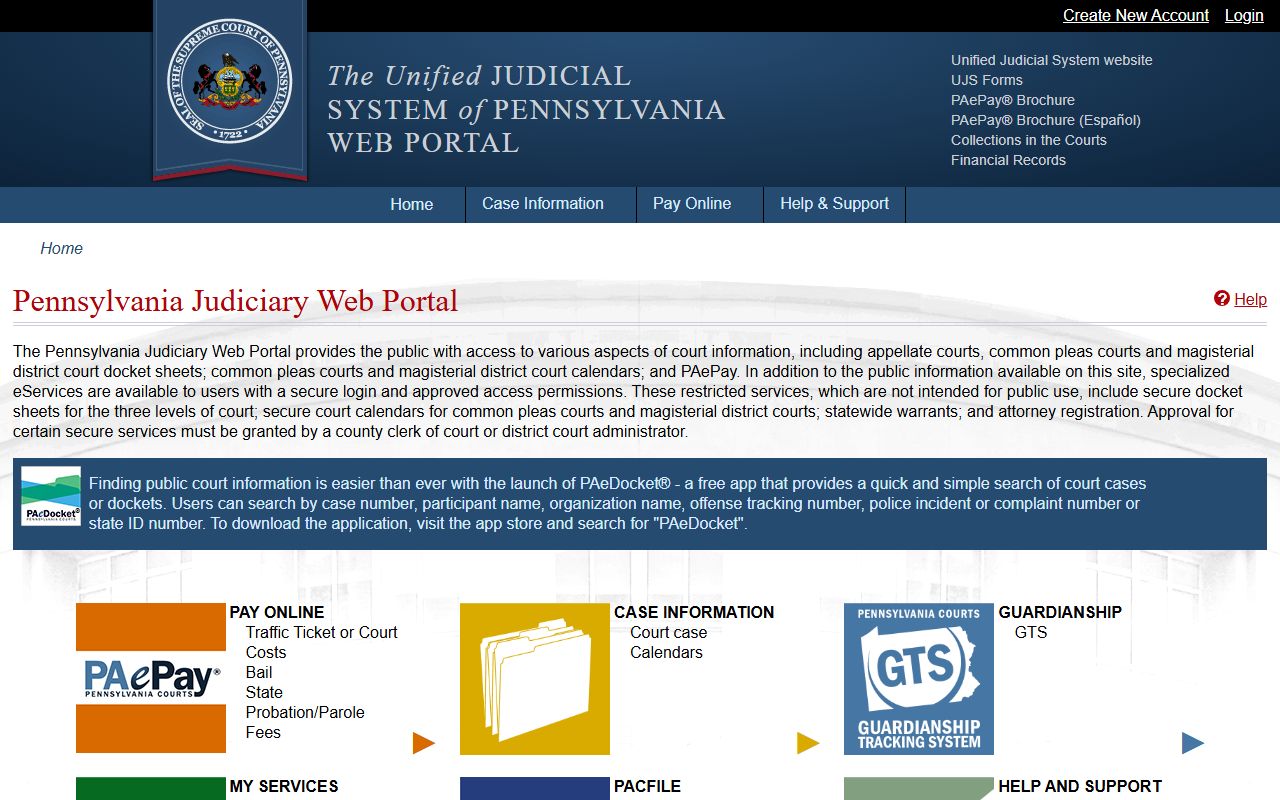
Through this portal, researchers can locate Centre County divorce docket entries, filing dates, and case summaries without visiting the Bellefonte courthouse in person.
Grounds and Procedures in Centre County Divorce Cases
Every divorce filed in Centre County is governed by 23 Pa.C.S. § 3301, which sets out the grounds available under Pennsylvania law. No-fault divorce is by far the most common approach. Under mutual consent, both parties agree to the divorce, and after a 90-day waiting period from the date of service, the court may enter a decree. When one party does not consent, a divorce may still proceed after the parties have been separated for one year. Fault grounds, including adultery, bigamy, cruel and barbarous treatment, and willful desertion, are also available and are occasionally pursued when the circumstances warrant.
The procedural framework for all Centre County divorce cases is established by Pennsylvania Rules of Civil Procedure Chapter 1920. These rules specify how complaints must be formatted and served, what affidavits are required, how master's hearings are conducted, and when a final decree can be entered. Familiarity with these rules helps researchers understand the sequence of documents they encounter when reviewing a Centre County divorce file. Cases involving contested property, alimony, or custody will contain many more filings than straightforward uncontested proceedings.
When property division is at issue, the court applies the equitable distribution standard of 23 Pa.C.S. § 3502. The court weighs factors including each party's income, the length of the marriage, contributions both monetary and non-monetary, and the economic circumstances of each spouse. Alimony determinations are made under 23 Pa.C.S. § 3701, with the court considering relative earning capacities, the standard of living established during the marriage, and other relevant circumstances. Both types of financial provisions become part of the permanent Centre County divorce record when they appear in the final decree or a related court order.
Note: Residents of Centre County who qualify for legal assistance can contact the Pennsylvania Legal Aid Network, which provides guidance on divorce law and court procedures to eligible individuals throughout the state.
Searching Centre County Divorce Records Online
The Pennsylvania Unified Judicial System case search portal provides free online access to Centre County divorce court dockets. Using party names or docket numbers, researchers can locate case summaries, filing dates, assigned judges, and chronological lists of docket entries. The portal is a reliable starting point for anyone researching a specific divorce case without knowing the full case details. For Centre County cases filed in recent years, document images may be available directly through the portal, allowing researchers to review actual filings without visiting Bellefonte.
Older divorce records in Centre County that predate electronic filing systems may only be accessible through in-person visits to the Prothonotary's Office. Physical case files, index books, and in some cases microfilm records cover past decades of civil court activity. Researchers looking for historical Centre County divorce records should contact the courthouse in advance to discuss what archival resources are available and how to arrange access. Bringing specific identifying information, such as the approximate year, party names, and any known docket references, will help staff locate the right records efficiently.
For a broader overview of how Pennsylvania divorce records are structured and what information a typical court file contains, additional context is available through Pennsylvania legal research resources. Understanding the general structure of a Pennsylvania divorce file makes it easier to interpret what you find in Centre County court records.
The Pennsylvania Courts of Common Pleas page explains how the state's county court system is organized and confirms Centre County's place within the unified judicial framework that governs divorce proceedings statewide.
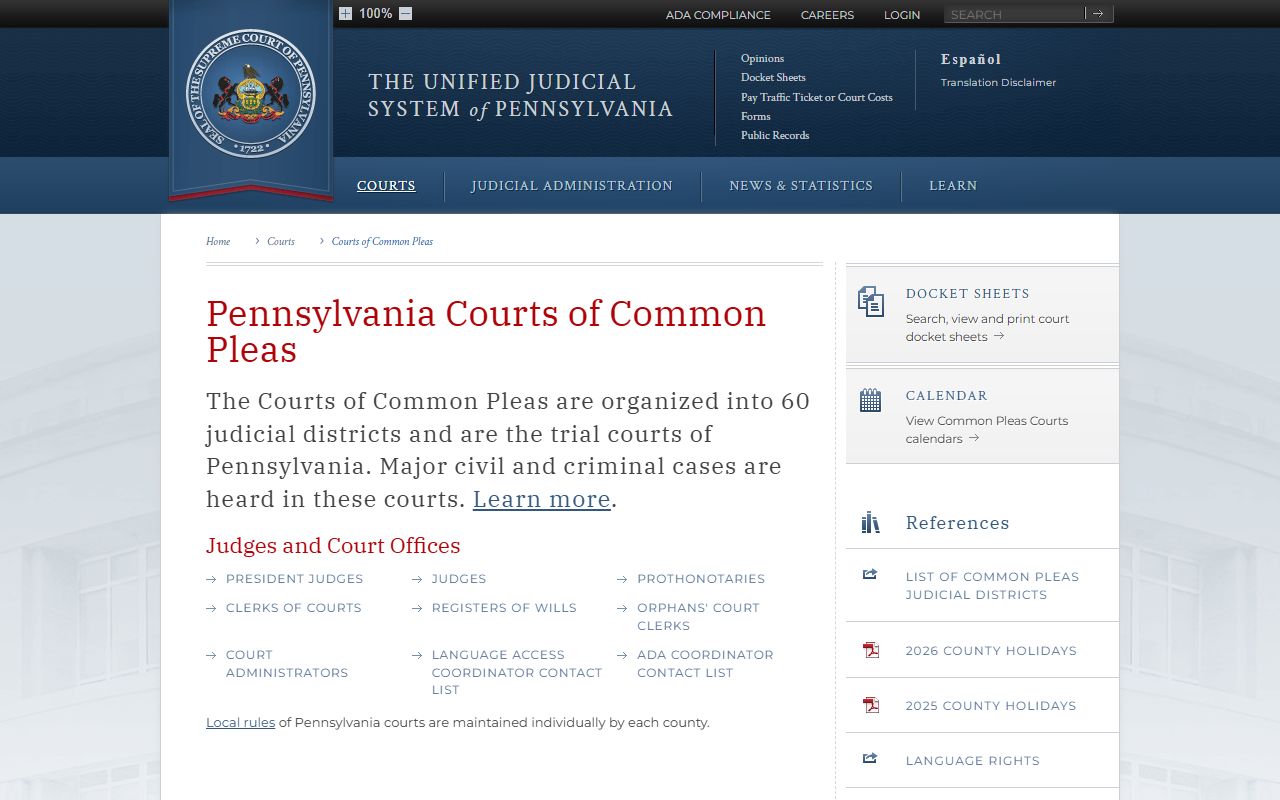
Centre County's Court of Common Pleas in Bellefonte operates within this unified state system, applying consistent legal standards to every divorce case filed in the county.
Centre County Divorce Records and Public Access
Pennsylvania's Right-to-Know Law at 65 P.S. § 67.101 affirms the public's right to access government records, including civil court filings maintained by the Prothonotary. The Pennsylvania Office of Open Records administers this law and provides guidance on how to pursue access when records requests are denied or delayed. In most cases, Centre County divorce records are straightforwardly available to any member of the public who visits the courthouse or submits a written request. Certified copies carry a per-page fee established by the court, while general file inspection is typically permitted at no charge during regular business hours in Bellefonte.
Certain document types within a divorce file may carry restricted access. Records involving minor children, sealed exhibits, and documents protected by specific court orders are not universally available. The Prothonotary's Office can clarify which portions of a specific file are open to public inspection and which may require a court order to access. For most standard Centre County divorce cases, however, the complaint, basic filings, and final decree are freely accessible. Researchers who encounter access questions should reference the Right-to-Know Law and consult the Office of Open Records for further assistance.
The full statutory basis for Centre County divorce proceedings is found in Pennsylvania Consolidated Statutes Title 23, which covers domestic relations law across the Commonwealth. Reviewing the relevant statutes can help researchers understand why certain documents appear in a Centre County divorce file and what legal standards the court applied when reaching its decisions.
Vital Records and Centre County Divorce Decrees
The divorce decree issued by the Centre County Court of Common Pleas is the primary legal document establishing that a marriage has been dissolved. It differs from the administrative certificate of divorce issued by the Pennsylvania Department of Health, which serves a more limited confirmation function. The Pennsylvania Department of Health maintains divorce certificates for qualifying proceedings, while the original court decree, with all its terms and findings, remains permanently on file with the Prothonotary in Bellefonte. Both documents may be needed depending on the purpose of the request.
Researchers with genealogical interests in Centre County can use the CDC's Pennsylvania vital records guide to understand what state-level resources are available and how to navigate them alongside county court records. Centre County's history as a community anchored by Penn State University in State College means its records reflect a diverse population, including longtime residents, academic community members, and families with deep roots in the surrounding townships and rural areas. Historical divorce records from earlier generations are preserved in courthouse archives and can provide valuable information for family history researchers.
Note: The Pennsylvania divorce records resource provides additional context on what to expect when searching family court filings throughout the state, which applies equally to Centre County records.
Cities in Centre County
Centre County includes Bellefonte as the county seat and State College as the county's largest community and home to Penn State University's main campus. Other communities in the county include Philipsburg, Milesburg, Howard, Boalsburg, Pleasant Gap, Pine Grove Mills, and numerous townships spread across the county's largely rural landscape. The diversity of these communities, from a major university town to small rural boroughs, is reflected in the range of divorce cases that come before the Centre County Court of Common Pleas. All divorce proceedings from residents of these communities are filed with the court in Bellefonte and maintained by the Prothonotary's Office for public access.
Nearby Counties
Centre County is surrounded by several other Pennsylvania counties in the heart of the state, each operating its own Court of Common Pleas for divorce and other civil matters.