
Venango County Divorce Records Access
Venango County is located in northwest Pennsylvania and has a strong historical connection to America's oil heritage. Divorce records for the county are maintained by the Prothonotary's Office at the Venango County Courthouse in Franklin. The Court of Common Pleas handles all divorce proceedings filed in the county. The county courthouse is a prominent feature of downtown Franklin, which serves as the center of county government services. Residents can request records through the Prothonotary or search case information online through the Pennsylvania Unified Judicial System.
Venango County Quick Facts
Venango County Divorce Records at the Courthouse
The Venango County Courthouse in Franklin is the official repository for all divorce records filed in the county. The Prothonotary's Office within the courthouse serves as the clerk for the Court of Common Pleas. Petitions, settlement agreements, master's reports, and final decrees are all maintained there as part of the permanent court record.
The Venango County official website at venangocountypa.gov features imagery of the courthouse and downtown Franklin. The site provides contact details for the Prothonotary and other county offices. The website also makes election information available, including Absentee and Mail-In Ballot Summaries, Registered Voter Counts, and 2% Audit Certification records.
Anyone needing a certified copy of a divorce decree or access to a case docket should contact the Prothonotary's Office directly. The office maintains records for all divorce cases decided by the Venango County Court of Common Pleas.
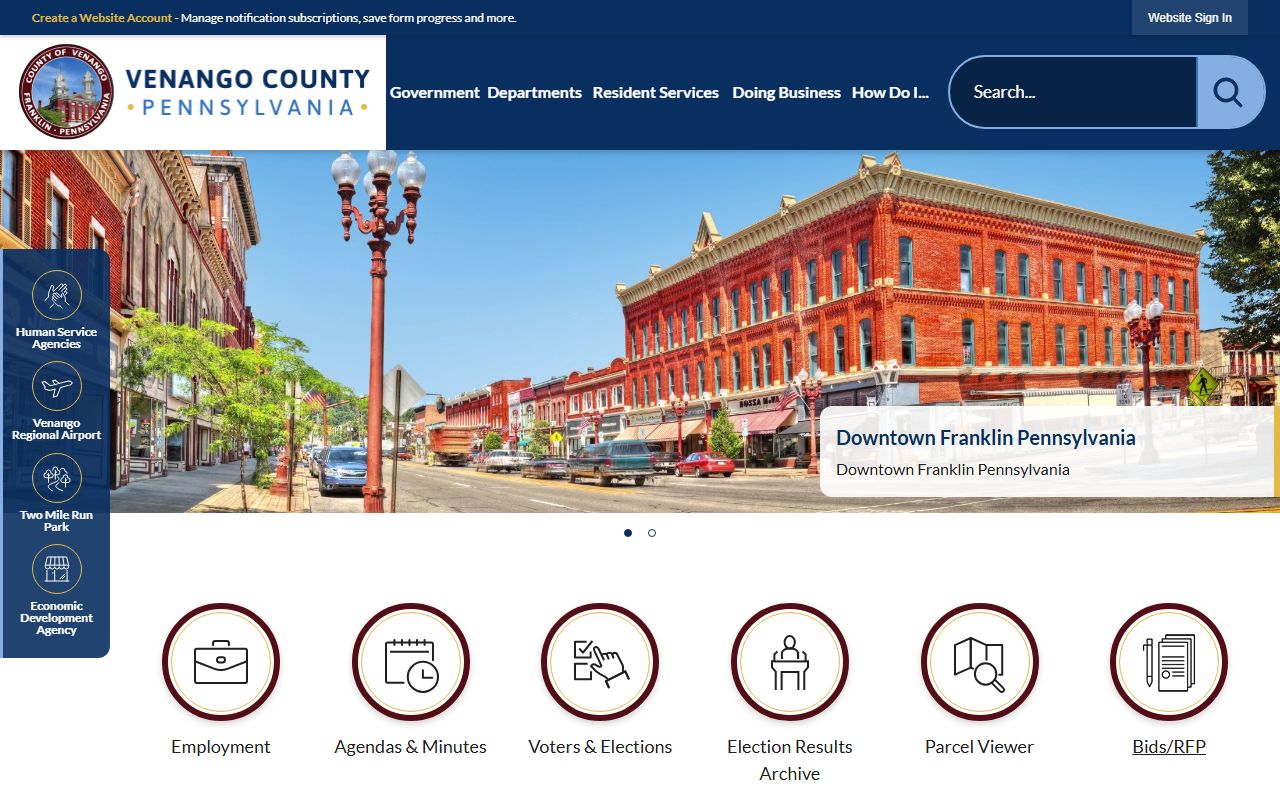
The Venango County official website at venangocountypa.gov features the Franklin courthouse and provides access to county services, election information, and Prothonotary contact details.
Searching Venango County Divorce Filings Online and In Person
The Pennsylvania UJS Case Search portal is a useful starting point for finding Venango County divorce records. Enter the name of either party and filter results by Venango County. The portal returns docket entries showing the case number, filing date, parties involved, and case status.
Not all historical records are available through the portal. Older cases may exist only in physical form. For those, a direct request to the Venango County Prothonotary's Office is needed. Staff can search the physical docket books and provide certified copies for a standard fee.
Written requests by mail are generally accepted. Include the full names of both parties and an approximate year of filing to speed up the search. The office serves a county of around 51,000 residents and can typically process requests within a reasonable time.
Under 65 P.S. § 67.101, Pennsylvania's Right-to-Know Law, court records are public unless sealed by a judge. Most divorce records in Venango County are open for public inspection.
Pennsylvania Divorce Statutes in Venango County Cases
Pennsylvania's divorce laws apply uniformly across all 67 counties. The governing statutes are found in Title 23 of the Pennsylvania Consolidated Statutes.
Section 3104 requires that at least one spouse be a Pennsylvania resident for at least six months before filing a divorce petition. This residency requirement is the threshold for establishing jurisdiction in Venango County. A petitioner must meet this standard before the Court of Common Pleas can accept the case.
Section 3301 sets out the grounds for divorce. No-fault divorce is the most common path in Pennsylvania. The two no-fault methods are mutual consent after a 90-day waiting period, and one-year separation without mutual consent. Fault-based grounds also remain available under state law.
When a divorce case involves assets or ongoing support, § 3502 on equitable distribution and § 3701 on alimony govern how those matters are resolved. The docket record in Venango County will reflect any motions or hearings related to these issues.
The procedural rules for divorce cases are set out in Chapter 1920 of the Pennsylvania Rules of Civil Procedure. The full text is published by the Pennsylvania Code and Bulletin.
Vital Records and State Divorce Documentation
Two types of records confirm a divorce in Pennsylvania. The Venango County Prothonotary holds the court file. The Pennsylvania Department of Health holds the state-level vital records index.
The Pennsylvania Department of Health's vital records office can provide certified documentation of a divorce for purposes such as remarriage, insurance, or estate administration. This type of certification is separate from the full court file held in Franklin.
The CDC's Where to Write resource for Pennsylvania guides researchers and individuals to the appropriate state agencies for divorce documentation. Venango County divorces are included in the state's records index.
The Pennsylvania Office of Open Records provides guidance on accessing public court records, including divorce filings maintained by the Venango County Prothonotary in Franklin.
Venango County Court of Common Pleas
The Pennsylvania Courts of Common Pleas are the trial courts of general jurisdiction across the state. Venango County's Court of Common Pleas serves the county's population and handles civil, criminal, and family law matters including divorce.
The Pennsylvania Unified Judicial System portal provides online access to case dockets for the Venango County court. Searching there can confirm whether a case exists and provide basic docket information. Detailed records or certified copies require contact with the Prothonotary in Franklin.
The Prothonotary assigns a docket number when a divorce petition is filed. That number remains the permanent identifier for the case and is used for all future references to the record.
Residents needing help with court access or the divorce process can contact PA Legal Aid. Legal aid services are available in northwest Pennsylvania and can assist residents with record requests and understanding the court system.
Open Records and Public Access in Venango County
Most divorce records in Venango County are public. The Pennsylvania Office of Open Records oversees the Right-to-Know Law framework and provides guidance on accessing government documents. For court records, the Prothonotary handles requests rather than a standard agency RTKL officer.
Financial affidavits filed during a divorce may have limited public availability in some cases. Orders involving minor children can also carry restricted access. Fully sealed divorce files require a specific court order and are uncommon in standard proceedings.
Further resources for Pennsylvania family court and divorce record searches are available through Pennsylvania Court Records.
About Venango County
Venango County has a distinctive place in American history as part of the region where the modern petroleum industry began. Oil Creek, which flows through the county, was the site of the first commercial oil well drilled in the United States in 1859. The county's oil heritage is reflected in its local museums and historical sites.
The county seat of Franklin sits at the confluence of French Creek and the Allegheny River. Downtown Franklin features the courthouse that houses the Prothonotary's Office along with other county services. The county's population of approximately 51,000 is spread across the city of Franklin and numerous townships and boroughs throughout the region.
Venango County borders Mercer, Butler, Clarion, Forest, and Crawford counties. Each of these neighboring counties maintains its own Court of Common Pleas and Prothonotary for divorce records.
Cities in Venango County
Venango County includes the city of Franklin as the county seat along with Oil City, which is a significant community in the county's oil history. Other communities include Sugarcreek Borough, Cooperstown, Clintonville, Pleasantville, Utica, and numerous townships including Cranberry, Sandy Creek, Mineral, and others. All divorce cases from any municipality within Venango County are filed with and held by the Prothonotary's Office at the Venango County Courthouse in Franklin.
Nearby Counties
Venango County is surrounded by several northwest and western Pennsylvania counties, each with their own divorce records at the local courthouse.