
Susquehanna County Divorce Records
Susquehanna County sits at the top of the Endless Mountains in Northeastern Pennsylvania, and its divorce records are maintained by the Prothonotary's Office at the county courthouse in Montrose. The Court of Common Pleas handles all divorce proceedings filed in the county. Anyone searching for a divorce record can request access through the Prothonotary or use the statewide online resources available through the Pennsylvania Unified Judicial System. Records reflect filings, decrees, and case documents going back many decades.
Susquehanna County Quick Facts
Susquehanna County Divorce Records at the Courthouse
The Susquehanna County Courthouse in Montrose is the central location for divorce records. The Prothonotary's Office inside the courthouse serves as the clerk for the Court of Common Pleas. All divorce petitions, agreements, and final decrees are filed and stored there. The county was formed in 1810, making it one of the older jurisdictions in the region.
Residents can visit the Prothonotary's Office in person during business hours. Written requests by mail are also accepted in most cases. The office maintains records for all divorce cases decided in Susquehanna County's Court of Common Pleas.
The county's official website at susqco.com provides contact information for the Prothonotary and other county offices. County Commissioners welcome visitors to the site and list available services for residents.
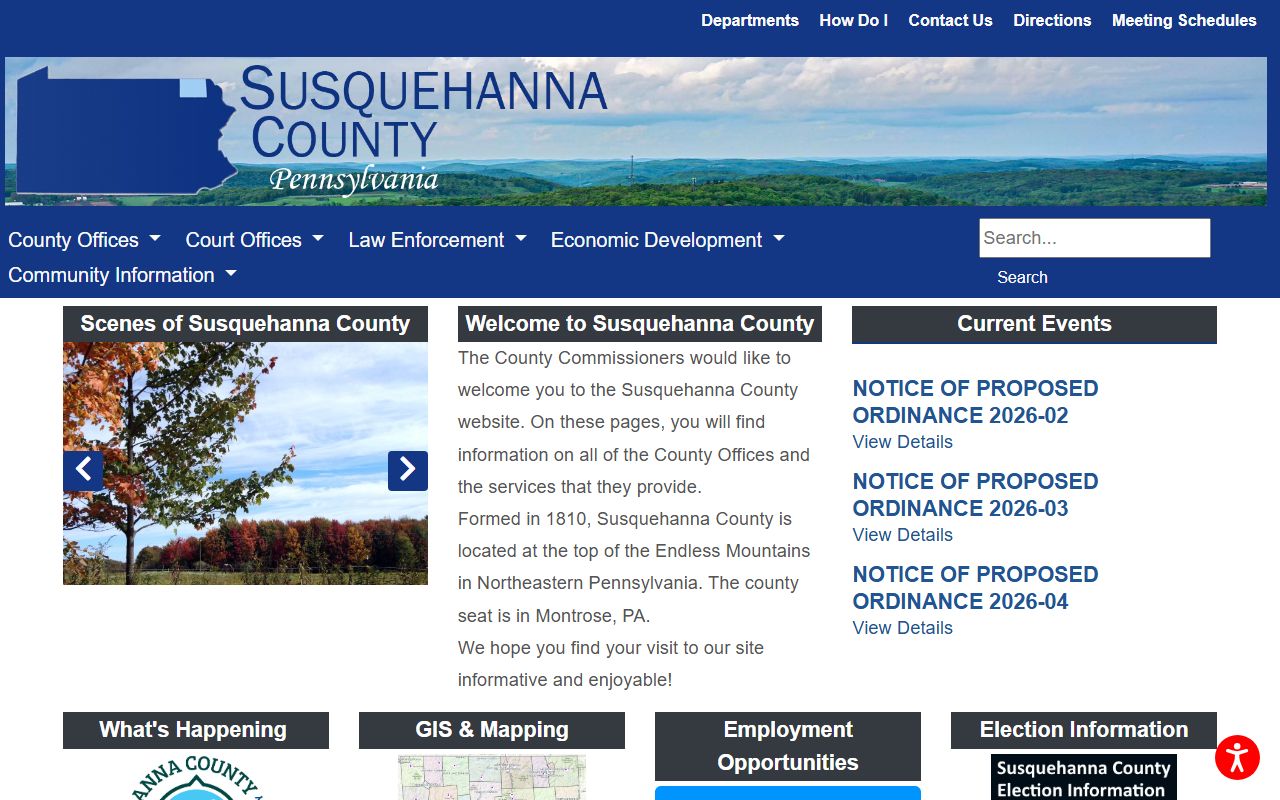
The Susquehanna County official website provides access to Prothonotary contact details, meeting schedules, and government services for the Endless Mountains region.
How to Search Susquehanna County Divorce Filings
There are two main paths to finding a divorce record in Susquehanna County. The first is through the statewide portal. The Pennsylvania UJS Case Search portal lets you look up court cases by party name, docket number, or filing date. Results include civil cases, family court matters, and divorce proceedings filed with the Court of Common Pleas.
The second path is direct contact with the Prothonotary's Office. Staff can help locate specific docket numbers and confirm whether a record is available for public viewing. Some older records may only exist in physical form and require an in-person visit to review.
Under 65 P.S. § 67.101, Pennsylvania's Right-to-Know Law, court records are generally accessible to the public unless sealed by a judge. Divorce records fall under this framework, though certain sensitive contents may be redacted upon request.
Pennsylvania Divorce Law: Key Statutes
Pennsylvania divorce law is governed by Title 23 of the Pennsylvania Consolidated Statutes. Several provisions are particularly relevant when researching records or understanding how cases are classified.
Under 23 Pa.C.S. § 3104, at least one spouse must have been a Pennsylvania resident for a minimum of six months before a divorce petition can be filed. This residency requirement determines which county court has proper jurisdiction over the case.
Section 3301 defines the grounds for divorce. No-fault divorce is available either through mutual consent with a 90-day waiting period or after one year of separation. Fault-based grounds are also available under state law. Most filings in Susquehanna County are no-fault matters.
Property division in Pennsylvania follows equitable distribution principles established under § 3502. Alimony provisions fall under § 3701. Both sections may be referenced in Susquehanna County docket records when a case involved contested assets or support disputes.
The full text of these statutes is available through the Pennsylvania Code and Bulletin, which publishes the Rules of Civil Procedure for Divorce under Chapter 1920.
Vital Records vs. Divorce Court Records
There is an important distinction between divorce decrees held by the court and divorce certificates maintained by the state. The Susquehanna County Prothonotary holds the court file, which includes the full docket, pleadings, and signed decree. The Pennsylvania Department of Health maintains a separate index of divorce records statewide.
The Pennsylvania Department of Health's vital records office allows individuals to request certified documentation of a divorce. This can serve different purposes than accessing a full court file. For genealogical research or legal verification, many people request both types of records.
The CDC's Where to Write resource for Pennsylvania also directs people to the appropriate state agency for certified vital event documentation. Susquehanna County divorces granted after a certain cutoff year are indexed at the state level.
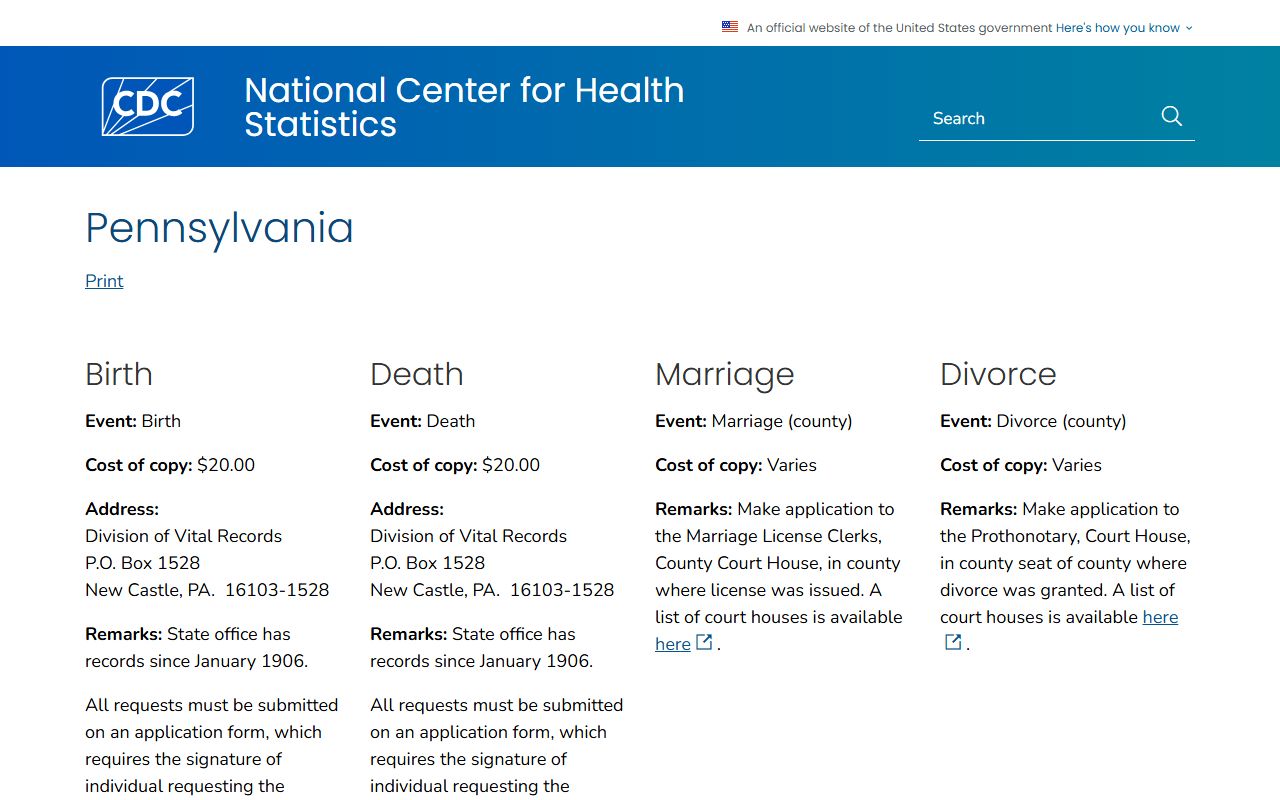
The CDC's Where to Write guide for Pennsylvania identifies state and local resources for obtaining certified divorce documentation from counties including Susquehanna.
Understanding the Court of Common Pleas in Susquehanna County
The Pennsylvania Courts of Common Pleas serve as the trial courts of general jurisdiction across the state. Each county has its own Court of Common Pleas. Susquehanna County is part of the judicial structure administered under the Pennsylvania Supreme Court's unified court system.
Divorce cases are filed in the Family Law division of Common Pleas. The Prothonotary accepts filings, assigns docket numbers, and maintains the complete record throughout the life of each case. After a decree is entered, the record remains with the Prothonotary indefinitely.
The Pennsylvania Unified Judicial System portal provides online access to many Common Pleas records. Searching by name returns docket entries that include filing dates and case dispositions. Not all older Susquehanna County records may be digitized, so direct contact with the courthouse remains the most reliable approach for historical cases.
Legal aid services are available to residents who need assistance navigating the divorce process. PA Legal Aid serves many rural Pennsylvania counties and can help with court access and record requests.
Open Records and Privacy in Susquehanna County Divorce Cases
Most divorce records in Pennsylvania are public documents. Court dockets, petitions, and decrees are generally accessible under the state's open records framework. However, financial affidavits and documents involving minor children may have limited access.
The Pennsylvania Office of Open Records oversees the Right-to-Know Law and provides guidance on how to request government documents. For court records specifically, the Prothonotary's Office rather than an agency RTKL officer handles most requests.
If a record has been sealed by court order, the requester will typically receive notice of the restriction. Sealing is uncommon in standard uncontested divorce proceedings.
More information about searching family court filings statewide is also available through Pennsylvania Court Records.
About Susquehanna County
Susquehanna County was formed in 1810 and is located at the top of the Endless Mountains in Northeastern Pennsylvania. The county seat is Montrose, a small borough that houses the main county government offices. The county borders New York State to the north and shares borders with several other Pennsylvania counties.
The county's rural character and small population mean that the Prothonotary's Office handles a manageable caseload. Staff are generally accessible and able to assist with record searches. The county government website at susqco.com lists office hours and contact information for all county departments.
The Endless Mountains region is known for its forests, outdoor recreation, and relatively quiet character compared to more urban parts of Pennsylvania. The county has a long history going back to its formation over two centuries ago.
Cities in Susquehanna County
Susquehanna County includes several boroughs and townships alongside the county seat of Montrose. Notable communities include Susquehanna Depot, Forest City, New Milford, Hallstead, Great Bend, Oakland, Clifford, Harmony, and Gibson. Each of these communities falls under the jurisdiction of the Susquehanna County Court of Common Pleas for family law matters, meaning divorce records for residents of any of these areas are filed and held at the Montrose courthouse.
Nearby Counties
Susquehanna County shares borders with several Pennsylvania counties, each maintaining their own Prothonotary offices and divorce records.