
Dauphin County Divorce Records in Harrisburg
Dauphin County divorce records are maintained by the Prothonotary's Office at the Dauphin County Courthouse in Harrisburg, Pennsylvania's state capital. The Court of Common Pleas processes all divorce filings for the county. As one of the more populous counties in Pennsylvania and the home of the state government, Dauphin County's court system handles a significant volume of family law cases annually. Records include all documents submitted during divorce proceedings, from the initial complaint through the final decree, and they are open to public access in accordance with Pennsylvania court rules and public records law.
Dauphin County Quick Facts
Dauphin County Divorce Records and the Harrisburg Courthouse
Harrisburg serves as both the county seat of Dauphin County and the capital of Pennsylvania, giving the city an unusually prominent role in the state's legal and governmental landscape. The Dauphin County Courthouse in Harrisburg houses the Court of Common Pleas and the Prothonotary's Office, which is responsible for maintaining all civil court records including divorce filings.
Because Harrisburg is the state capital, Dauphin County's court system operates in close proximity to the state Supreme Court and the administrative infrastructure of Pennsylvania's unified judicial system. The Dauphin County government website provides information on court services, office hours, and department contacts. The volume of cases handled annually by the Dauphin County Court of Common Pleas is among the highest in the state outside of the Philadelphia and Pittsburgh metropolitan areas, reflecting the county's population size and its role as a regional center.
All divorce proceedings in Dauphin County follow the same Pennsylvania Rules of Civil Procedure that govern courts across all 67 counties, including the detailed procedural rules in Chapter 1920 specific to divorce actions.
Dauphin County Prothonotary and Divorce Case Management
The Dauphin County Prothonotary's Office is the central hub for all civil court records in the county. The office accepts divorce complaints, assigns docket numbers, records all subsequent filings, and maintains the permanent case archive. The Prothonotary is an elected position accountable to Dauphin County voters.

The county government website provides direct links to Prothonotary services, making it straightforward for residents to identify the right office before contacting the courthouse.
All divorce cases filed in Dauphin County are indexed by party name and docket number. This indexing system makes it possible to locate a specific case with basic identifying information. Staff at the Prothonotary's Office assist visitors in person and handle mail requests for copies. Given the high case volume, having the docket number in advance significantly speeds up any inquiry.
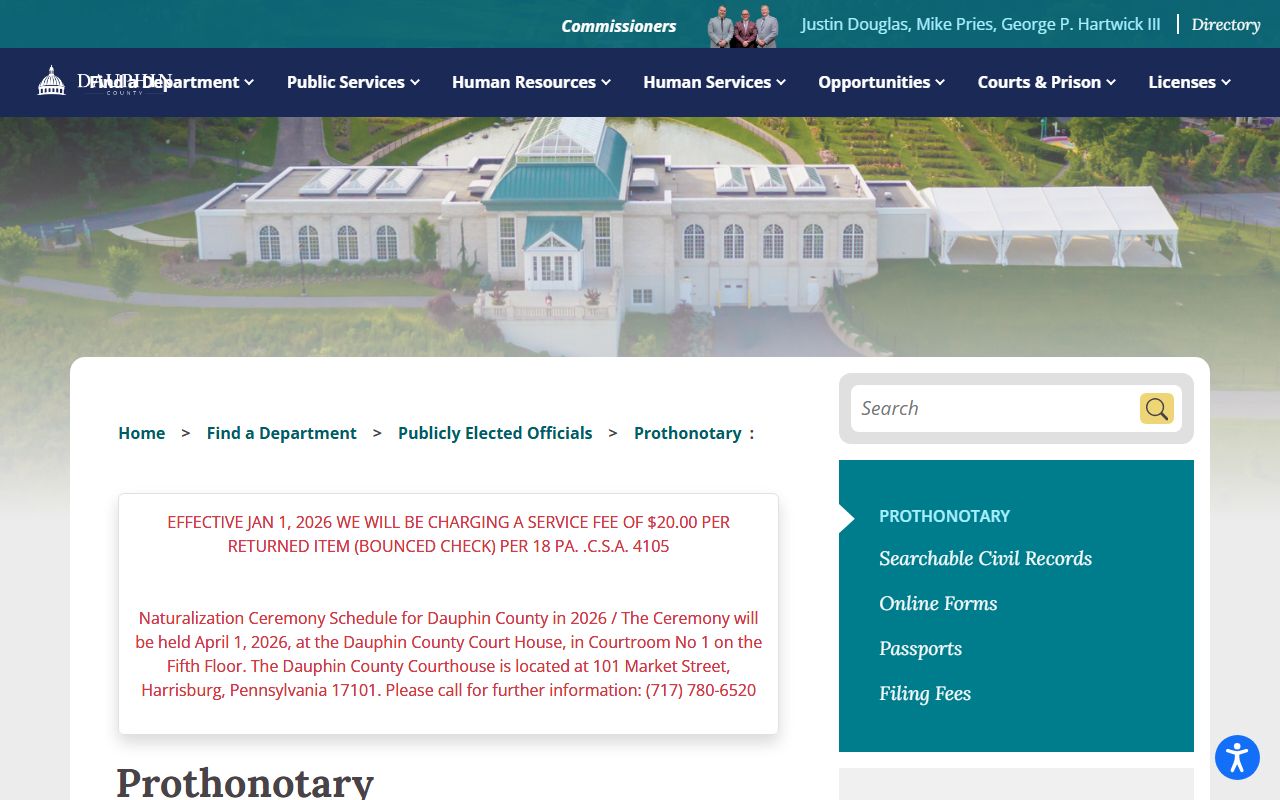
The Prothonotary's Office page outlines available services, accepted payment methods for copy requests, and contact information for staff assistance.
Note: As a high-volume court system, processing times for copy requests in Dauphin County may be longer than in smaller counties. Contacting the office by phone before visiting is recommended.
Filing for Divorce in Dauphin County
Divorce filings in Dauphin County begin with the submission of a complaint to the Prothonotary. Pennsylvania law under 23 Pa.C.S. § 3104 requires that at least one spouse have resided in the Commonwealth for a minimum of six months before a complaint may be filed. Dauphin County residents who meet this threshold can proceed with filing regardless of how long the other spouse has lived in Pennsylvania.
Pennsylvania recognizes no-fault divorce as the primary pathway under 23 Pa.C.S. § 3301. Mutual consent requires both parties to file affidavits of consent no sooner than 90 days after the complaint is served. Irretrievable breakdown divorce requires the parties to have been living separately for at least one year. Fault grounds, including adultery, cruel and barbarous treatment, and willful desertion, are also available under the statute but require evidentiary hearings and are more resource-intensive to litigate. Most Dauphin County divorce cases proceed on a no-fault basis.
The complete statutory framework for Pennsylvania divorce law is available at Title 23 of the Pennsylvania Consolidated Statutes. Additional explanatory resources are available through Pennsylvania family court records.
Searching Dauphin County Divorce Records Online
The Pennsylvania Unified Judicial System's online case search tool covers Dauphin County Court of Common Pleas records. The UJS Case Search portal is publicly available at no cost. Users can search by the names of the parties or by docket number. Results include the names of the parties, the filing date, case status, and a list of all docket entries recorded in the case.
The UJS portal is a practical tool for confirming case details and identifying docket numbers before contacting the Prothonotary. Given the high volume of cases in Dauphin County, the online portal can save significant time by narrowing down the relevant case information in advance. Full document images are generally not available through the portal, so copies of filed documents must be requested from the Prothonotary's Office separately.
Mail requests to the Dauphin County Prothonotary should include both parties' full names, the approximate filing year, the docket number if known, and a form of payment for any applicable copy fees. The office can confirm current procedures and fees by phone.
Property Division and Alimony in Dauphin County Divorce Cases
Divorce cases in Dauphin County frequently involve the division of significant marital estates given the county's relatively high income levels and proximity to state government employment. Pennsylvania's equitable distribution statute at 23 Pa.C.S. § 3502 governs how marital property is divided. The court evaluates a wide range of factors, including the length of the marriage, the income and earning capacity of each spouse, contributions to marital assets, and any prior support obligations. Equitable distribution does not guarantee an equal split but aims for a fair result given the totality of the circumstances.
Alimony decisions in Dauphin County are governed by 23 Pa.C.S. § 3701. Courts may award alimony when one spouse does not have adequate income or resources to sustain a reasonable standard of living following the divorce. Factors include relative earnings and earning capacity, the duration of the marriage, age and health of the parties, and contributions each made to the other's education or career advancement. All property division and alimony orders are part of the Dauphin County court record and are accessible through the Prothonotary.
Certified Copies and Public Access to Dauphin County Divorce Records
Certified copies of Dauphin County divorce decrees are available from the Prothonotary's Office. These documents bear the court's official seal and are accepted as legal proof of the dissolution of marriage for a wide range of purposes. Requests should include identifying information about the case and an appropriate form of payment for the copying fee.
Pennsylvania's Right-to-Know Law at 65 P.S. § 67.101 supports public access to government records. The Office of Open Records provides detailed guidance on how citizens can access records and what remedies are available if a request is denied. For court records specifically, the Prothonotary is the correct point of contact, as court records fall primarily under judicial branch rules rather than the executive-branch Right-to-Know framework.
The Pennsylvania Department of Health offers divorce verification services for cases reported to the state vital records system. For individuals who need a full certified court document rather than a verification letter, the Prothonotary's Office is the appropriate source. Residents seeking legal guidance can reach PA Legal Aid for free assistance with divorce-related legal questions.
Cities in Dauphin County
Dauphin County is anchored by Harrisburg, the state capital and county seat. Other significant communities include Steelton, Middletown, Hummelstown, Millersburg, and Elizabethville. The county also encompasses a number of townships and boroughs that contribute to its diverse mix of urban, suburban, and rural character. Hershey, home to Penn State Health Milton S. Hershey Medical Center and the Hershey Company, is also located in Dauphin County, adding to the county's economic and institutional profile. All divorce proceedings for county residents are centrally handled at the Harrisburg courthouse.
Nearby Counties
Dauphin County is surrounded by several Pennsylvania counties, each of which maintains its own Court of Common Pleas and public divorce records system.