
Cambria County Divorce Records and Court Filings
Cambria County divorce records are held by the Prothonotary's Office at the Cambria County Courthouse in Ebensburg, a historic seat of government in the Laurel Highlands region of Pennsylvania. The Court of Common Pleas manages all divorce cases filed within the county, and the Prothonotary maintains the official docket for each proceeding from initial filing through final decree. Researchers, attorneys, and members of the public can access these records through the courthouse directly or through the Pennsylvania Unified Judicial System's online portal. Cambria County was established on March 26, 1804, giving it a long history of civil court records stretching back more than two centuries. Whether seeking a recent decree or historical case information, the county's record-keeping systems accommodate a range of research needs.
Cambria County Quick Facts
The Cambria County Prothonotary and Divorce Record Custody
The Prothonotary is an elected row officer in Cambria County, responsible for managing all civil court records including divorce filings. The office operates within the Cambria County Courthouse in Ebensburg, which is open Monday through Friday from 9 a.m. to 4 p.m. Anyone seeking to inspect divorce records, obtain certified copies, or file new court documents must do so within these hours. It is worth noting that the courthouse no longer provides notary services, a detail that affects those who need notarized copies for legal or administrative purposes.
The Cambria County Prothonotary office page explains the functions of the office, contact information, and procedures for requesting records. For divorce cases specifically, the Prothonotary maintains every document from the initial complaint through the final decree, along with any intervening orders, motions, and financial disclosures. Each case receives a unique docket number that serves as the key identifier for locating all associated documents. The Cambria County official website provides broader government information and links to various county offices and services.
Under 23 Pa.C.S. § 3104, at least one party must have resided in Pennsylvania for six months before a divorce action can be initiated. This residency requirement ensures that the Court of Common Pleas in Cambria County has proper jurisdiction over the proceedings. Once jurisdiction is established and the case is filed, the Prothonotary's record-keeping responsibilities begin.
The Cambria County official government website provides access to county departments, elected row offices, and public services, including information about the Prothonotary's role in managing court records.
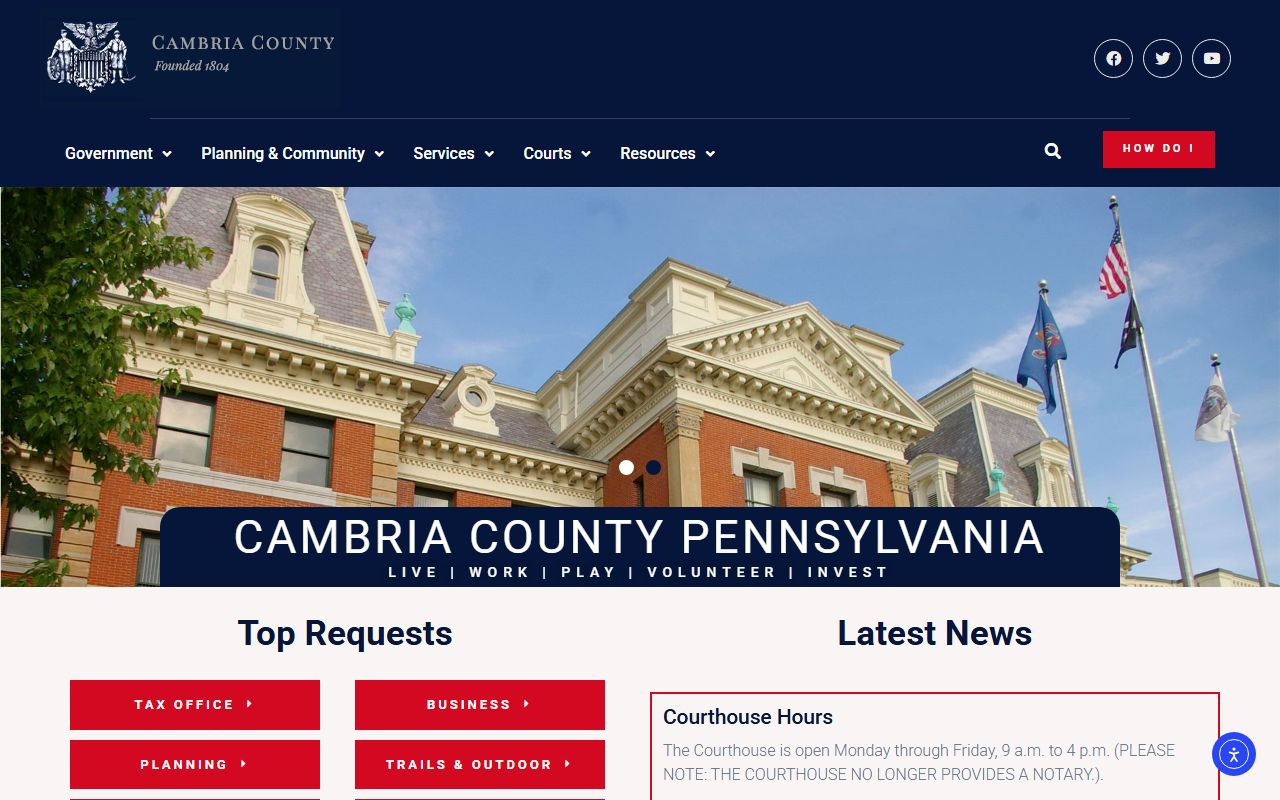
This portal connects residents and researchers with the resources needed to navigate Cambria County court records, including divorce filings maintained by the Prothonotary's Office in Ebensburg.
Grounds for Divorce in Cambria County Cases
Pennsylvania law under 23 Pa.C.S. § 3301 provides multiple grounds for divorce that apply to every case filed in Cambria County. The most commonly used path is no-fault divorce, which can proceed in one of two ways. Mutual consent divorce allows both parties to agree on dissolution after a mandatory 90-day waiting period from the date of service. Alternatively, a divorce may be granted after the parties have lived separately for at least one year. Both routes are reflected in Cambria County divorce records, with the specific ground noted in the initial complaint and confirmed in the final decree.
Fault-based divorce remains available under Pennsylvania law, though it is pursued far less frequently. Grounds such as adultery, cruel treatment, bigamy, and desertion require evidentiary support and typically result in more extensive court records. Cambria County divorce files involving fault grounds may include witness testimony transcripts, evidentiary motions, and findings of fact from a master or judge. These records remain public in the same manner as no-fault cases. Researchers should be aware that contested cases of any type generate significantly more documentation than uncontested proceedings.
Note: The Pennsylvania Legal Aid Network can connect eligible Cambria County residents with free legal guidance on the divorce process, including which grounds may be most appropriate for their circumstances.
The Cambria County Prothonotary's Office page provides direct information about the elected official responsible for maintaining all civil court filings, including Cambria County divorce records.
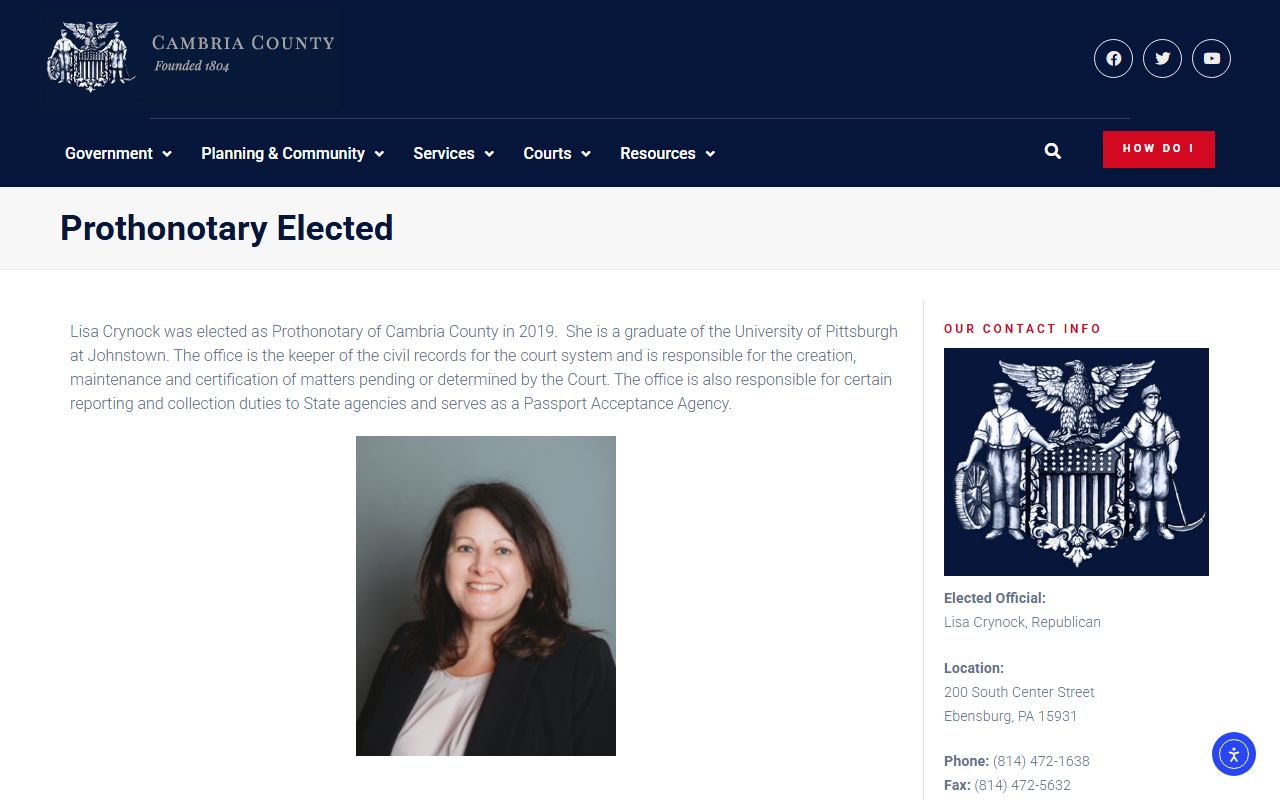
Contacting the Prothonotary's Office directly is the most reliable way to request certified copies of Cambria County divorce decrees or to arrange in-person inspection of a specific case file.
Searching Cambria County Divorce Records: Online and In-Person Options
The Pennsylvania Unified Judicial System case search portal provides free online access to Cambria County court dockets. Researchers can search by party name or docket number and retrieve case summaries showing filing dates, assigned judges, and docket entry histories. This tool is particularly useful for identifying the docket number of a specific case before visiting the courthouse in person to request physical documents. The portal covers cases filed throughout the statewide system, including all civil matters handled by the Cambria County Court of Common Pleas.
In-person access to Cambria County divorce records requires visiting the Prothonotary's Office during courthouse hours, Monday through Friday from 9 a.m. to 4 p.m. Staff can retrieve physical files based on docket number, party name, or approximate filing date. For older cases not yet digitized, original paper filings or microfilm records may be the only available format. Researchers should arrive with as much identifying information as possible to facilitate the search. Certified copies are available for a fee payable to the Prothonotary's Office at the time of the request.
The Pennsylvania Unified Judicial System portal also offers broader access to court information statewide, including contact details for every Court of Common Pleas in Pennsylvania. For those unfamiliar with how Pennsylvania's court structure operates, the Pennsylvania Courts of Common Pleas overview provides a helpful primer on how each county court fits within the statewide judicial system.
Cambria County Divorce Records: Property and Financial Documents
Cambria County divorce records frequently include financial documentation related to the division of marital property. Pennsylvania's equitable distribution standard under 23 Pa.C.S. § 3502 requires the court to consider numerous factors when allocating assets and debts, including the length of the marriage, each party's economic circumstances, and non-monetary contributions such as homemaking or childcare. Property inventories, financial affidavits, appraisals, and negotiated settlement agreements all end up in the court file when property is at issue. In uncontested cases where parties reach an agreement, those terms are incorporated into or appended to the final divorce decree.
Alimony provisions in Cambria County divorce cases are governed by 23 Pa.C.S. § 3701. The statute outlines the factors judges consider when determining whether alimony is appropriate, including the relative earning capacities of both spouses, the duration of the marriage, and the standard of living established during the marriage. Alimony terms that result from court orders or negotiated agreements are included in the final decree or in a separate support order and become part of the permanent record maintained by the Prothonotary. Researchers reviewing a Cambria County divorce file will typically find these financial provisions clearly documented.
Under 65 P.S. § 67.101, Pennsylvania's Right-to-Know Law, government records including civil court filings are generally available to the public. The Pennsylvania Office of Open Records administers this law and provides guidance on requesting records that may not be immediately available. While court records operate under their own access rules, the principle of public access applies broadly to Cambria County divorce records.
Vital Records and Cambria County Divorce Documentation
The final decree issued in a Cambria County divorce case is the primary legal document confirming that a marriage has been dissolved. This court-issued decree is distinct from the administrative certificate of divorce maintained by the Pennsylvania Department of Health. Both documents serve important purposes, and researchers often need to understand the difference. The Pennsylvania Department of Health vital records office can provide a certificate confirming that a divorce occurred, while the full case file, including all court documents and the detailed decree, remains with the Cambria County Prothonotary.
Historical researchers tracing family records in Cambria County may also find the CDC's Pennsylvania vital records guide useful for understanding what state-level records exist and how to access them. Cambria County's long history, dating to its establishment in 1804, means that older divorce records may require additional patience and specialized search techniques. The Prothonotary's Office can advise on the best approach for locating historical filings. For a broader overview of Pennsylvania divorce records and the family court system statewide, additional context is available through dedicated Pennsylvania legal research resources.
Note: The procedural rules governing every Cambria County divorce case are found in Pennsylvania Rules of Civil Procedure Chapter 1920, which covers everything from how the complaint must be formatted to the steps required before a final decree can be issued.
Cities in Cambria County
Cambria County includes Ebensburg as the county seat and a number of other communities spread throughout the Laurel Highlands region. Johnstown, the county's largest city, has a rich industrial history and is home to a significant portion of the county's population. Other communities include Portage, Cresson, Patton, Carrolltown, Loretto, and Gallitzin. Residents of all these communities file divorce proceedings with the Court of Common Pleas in Ebensburg, and all resulting records are maintained by the Prothonotary's Office at the Cambria County Courthouse. The county's scenic location near state forests and Duman Park, which offers camping and outdoor recreation, makes it a distinctive part of central-western Pennsylvania.
Nearby Counties
Cambria County is surrounded by several Pennsylvania counties, each maintaining its own divorce record systems through local Courts of Common Pleas.